Heating
Furnace installation and replacement in Pueblo
Replacing a furnace is a bigger decision than a repair, and in Pueblo it comes with a permit, an inspection and a state alarm rule. This page walks through each part so the conversation with a contractor is easier.
When replacement comes up
A contractor may recommend it after finding a crack in the heat exchanger, after the third major repair in a few winters, or when a control part for an old model is no longer made. Each of those deserves a clear explanation.
Ask to see what was found. A photo of the cracked section or the combustion test readings makes the choice easier to judge.
Size from a calculation, not from the old label
Pueblo's climate leans hard toward heating. NOAA's normals for the airport show about 5,334 heating degree days a year against about 1,078 cooling degree days, so the furnace does most of the yearly work.
That doesn't mean bigger is safer. An oversized furnace heats in short bursts, wears its parts faster and leaves rooms uneven. A room-by-room heat-loss calculation accounts for insulation, windows and any additions made since the old unit went in.
Standard or condensing, and what that means for venting
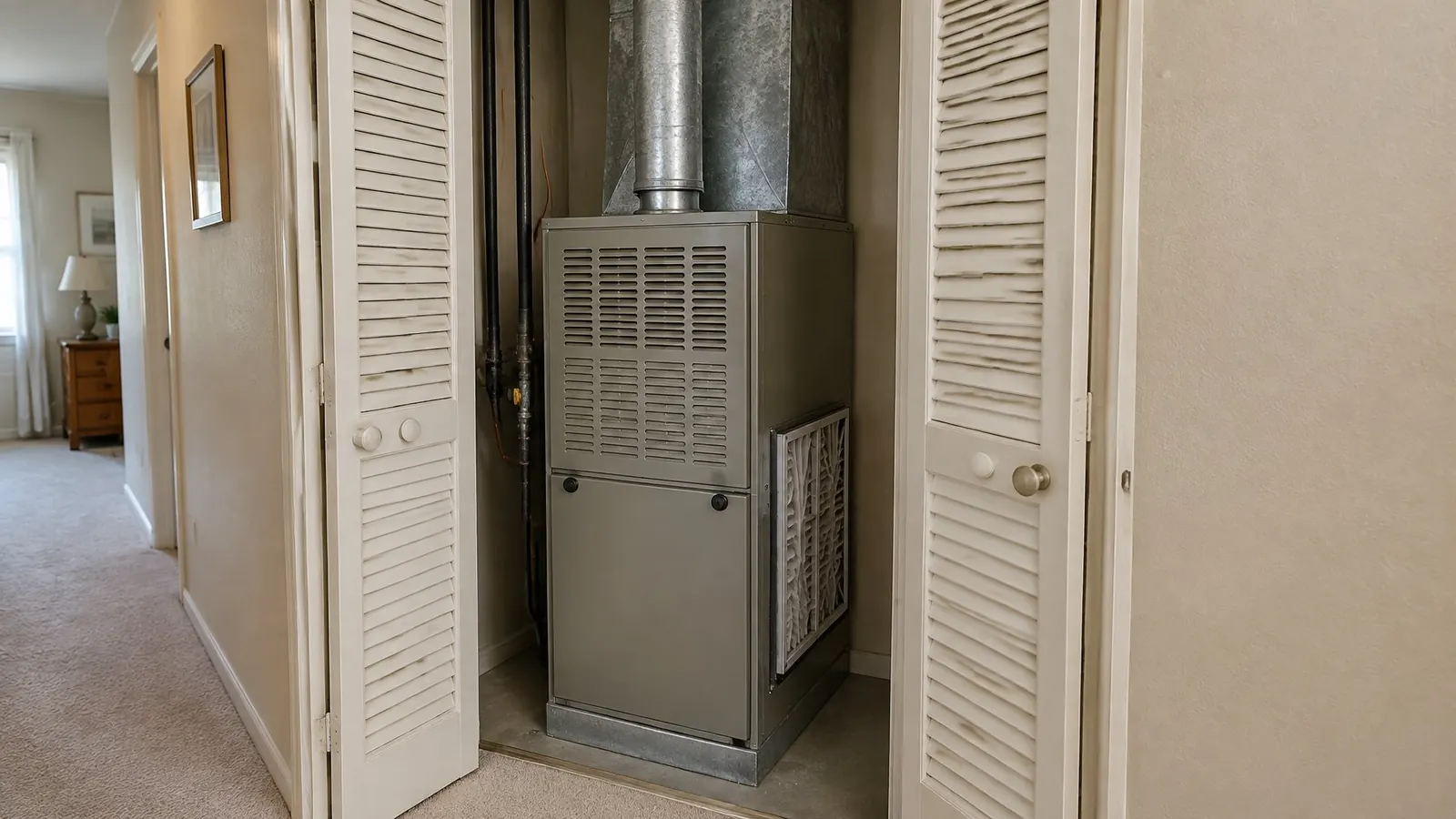
A standard-efficiency furnace sends hot exhaust up a metal flue, often into a masonry chimney. A condensing furnace pulls so much heat from the exhaust that it vents through plastic pipe, usually out a side wall, and drains water.
Changing from one type to the other changes the venting, needs a drain, and can leave other gas equipment alone in an oversized chimney. Ask how the contractor plans to handle each of those in your house.
- Where the new vent and air intake pipes will leave the house.
- Where the condensate drain goes, and how it's kept from freezing.
- Whether the chimney needs a liner once the furnace no longer shares it.
The permit, city or county
Inside the City of Pueblo, permits come from the Southern Colorado Building Department. Its 2026 fee table lists fixed-fee residential mechanical permits for a furnace replacement without ductwork, for an AC replacement, and for both together. The department runs its own mechanical inspection staff.
In unincorporated Pueblo County, including Pueblo West, the county building division issues the permit. County code section 15.10.320 says that when a job is limited to mechanical work, the mechanical contractor obtains the mechanical permit.
In the city, a homeowner can take out a permit only for a single-family house the owner lives in, according to SoCoBD.
The carbon monoxide alarm that comes with it
Colorado law, C.R.S. 38-45-102, covers single-family homes with a fuel-fired appliance, a fireplace or an attached garage. When a fuel-fired appliance is replaced under a building permit, an operational carbon monoxide alarm must be installed within fifteen feet of the entrance to each room used for sleeping, or where the building code says.
A gas furnace replacement fits that description. The carbon monoxide guide covers placement and testing.
Energy code in the city
The Southern Colorado Building Department reports that the City of Pueblo adopted the 2021 International Energy Conservation Code, effective 30 June 2026, for plans and permits submitted from 1 August 2026. The installing contractor works to whatever applies on the day the permit is filed.
What drives the price of a new furnace
No figures here, because they swing with the house. These are the items that move it:
- Standard or condensing efficiency, and single-stage, two-stage or variable-speed operation.
- Venting changes, a chimney liner or new wall penetrations.
- Duct changes at the furnace, such as a new plenum or return.
- Gas line work, including a pressure test.
- Whether the AC coil on top of the furnace is reused or replaced at the same time.
- Access: a tight hall closet, a basement stair or a crawlspace.
- The permit and the inspection visit.
Replacing the furnace and the AC together
The furnace blower moves air for both heating and cooling, and the AC's indoor coil usually sits on top of the furnace. If the air conditioner is near the end of its life too, one project can cover both and the city fee table has a combined furnace and AC permit for it. See the AC installation and replacement page for that side of the job.
Questions for the contractor before you sign
- Which license do you hold with the Southern Colorado Building Department or with Pueblo County?
- Who pulls the permit, and when is the inspection?
- How did you size the new furnace?
- Where will the vent pipes and the condensate drain go?
- Will you install the carbon monoxide alarms the state requires, or should I?
- What does the written estimate include, and what would count as extra?
- Who registers the manufacturer's equipment warranty?
Questions
How long does a furnace usually last?
There's no fixed number. Venting, filter habits and how hard the unit works all matter. A contractor can tell you what condition yours is in.
Can I keep the old ductwork?
Often, yes. The contractor checks whether the existing ducts suit the new furnace's airflow before deciding.
Is a condensing furnace always the right choice?
Not always. Venting routes, drain access and the age of the chimney all play into it, so ask for both options explained.
Cold house, warm house, or a system you're unsure about?
Call and describe what the furnace or air conditioner is doing. You'll be put through to an independent HVAC contractor who works in Pueblo, and the two of you take it from there.